

High Country Trail Shoe




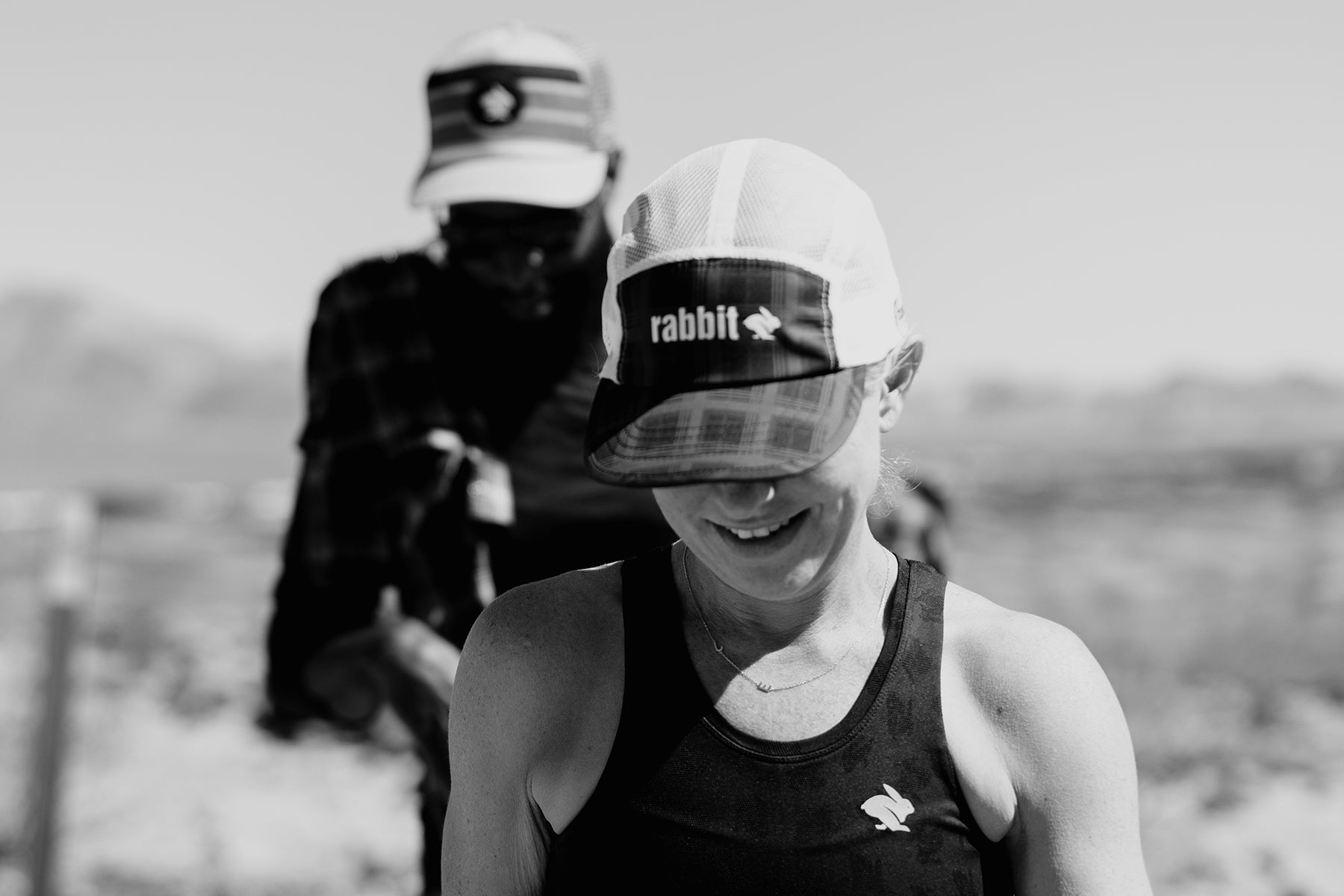




HELEN PAYNE
Helen's Adventures in Wanderland
"Curiouser and curiouser!” cried Alice.
—
Alice’s Adventures in Wonderland, by Lewis Carroll
By Brent Terry
Helen Payne’s curiosity is not of the idle variety. When one’s cross-training regimen was once swinging a machete, killing “about 37,000” invasive coconut palm trees in between runs on a WWII-era airstrip on a dot of coral 1,000 miles south of Hawaii, one’s curiosity cannot be termed “idle.”. When one rewards oneself for being among the top finishers of a 100-mile trail race through the Rockies by signing up for a 200-mile race through the Sierras, one’s curiosity cannot be termed “idle.” When one is able to don simultaneously one’s scientist hat and one’s elite athlete hat, pondering the relationships between the flowers and insects one sees while flying along a trail on the side of a Colorado mountain, all while in the throes of gastric distress, well, curiosity just might be the guiding principle in one’s life.
Curiosity by itself, of course, accomplishes very little. Curiosity must breed caring. Caring must generate hard work. To be sure, asking “why” and “what if” is a great place to start. Doing everything in one’s power to answer those questions, however, and being able to live with the answers, is a different creature altogether. It’s uncomfortable, exhausting, scary, to go boldly in the direction curiosity points. It’s also fun. And answering the hard questions changes not only the one asking the questions, but the world. Helen Payne has been happily chasing those answers, at speed and over varied surfaces, ever since she was a child.


I caught up with Payne at a spot in her running where recovery from July’s High Lonesome 100, (where she finished in seventh place) was morphing into training for the Mammoth 200 – her first 200-mile race – to be run on September 26th.
“I feel good,” she said, commenting about the effects of running for over 26 hours at over 12,000 feet of altitude, some of it while not feeling super swell. “My stomach went south in the second half of the race, but I was moving well, and it was really fun.” She said that her body responded positively after High Lonesome, and that training for Mammoth was going surprisingly smoothly.
About five minutes into our first phone conversation, I asked Payne, a rabbit Elite Ultra team member and PhD candidate in Plant Ecology and Evolution, about curiosity, whether it was curiosity that led her to run a 200-mile ultra so soon after completing one of the more difficult 100-milers in America.
“Oh! Yes!” she said, warming to the topic immediately. “Curiosity is everything.” Then she laughed. “Of course, someone needs ban me from Ultra Signup immediately after races. I’m so fired-up, and so many races look interesting. I want to run them all!”
This is something that a quick perusal of said website bears out. Ultra Signup reveals a runner with an impressive resume of races of all sizes over a variety of distances and geographical profiles, and with uniformly consistent performances. And all in a surprisingly short span of time. Payne has run almost thirty ultras, all between the age of 23 and 28. I tell her it is strange to be talking to someone who is both a grizzled veteran and a neophyte.
Payne ran her first ultra, the Marlette 50k at Lake Tahoe, in 2020. It was one of the first races to open back up after the global pandemic, and after several months doing research and conservation work, helping to eradicate invasive coconut palms on the remote Palmyra Atoll in the South Pacific, she was ready to jump back into the world, attack a race high above sea-level.
“We thought people were playing a joke on us,” she says of hearing about Covid while isolated on an island thousands of miles from civilization with only a handful of similarly flummoxed companions, “We were there four months, completely missed all the lockdowns. We were boiling our food. It was crazy. The world really did change while we were out there.”
So, what better way to respond to a world fundamentally changed than to do something familiar: to lace up the rugged sneakers and put one foot in front of the other for a few hours? Though Payne had never raced longer than a marathon before Marlette in August of 2020, she had been running and racing since elementary school, driven not by a competitive fire, but by a deep curiosity about the world and the pure joy of moving through that world at a decent clip.
“Early on” she says, “I didn’t even know there was any difference between road running and trail running. There wasn’t as much of the whole trail racing scene. Things have really changed.”


By the time Payne had graduated from Cal Poly, she had been running for more than ten years. She had grown up in Dana Point, California, surrounded by wilderness and water, and had participated in a running program in elementary school, where students ran a marathon, one mile at a time, over the course of a month. She was hooked. When she was in seventh grade, Payne ran the LA Marathon – all at once – as part of a program called Students Run LA.
I asked if her parents had helped instill the curiosity that had led her to a life of running and science.
“My parents signed me up for the after school running program in elementary school,” she says, “But I think SRLA was my choice. But yes, they definitely inspired me! My mom has always been my biggest cheerleader and my dad has always encouraged me to go out and explore nature.”
After middle school the exploration continued. More marathons and other road races followed. By any definition, by the time Helen Payne entered high school, she was a runner. Still, the conventional route for a young, competitive runner, was a new one for her. She ran high school cross county with little success, at least early on. Maybe the races were too short and fast for someone already well-versed in long road races, maybe the cutthroat world of SoCal high school cross country was a difficult transition. Either way, it was not the kind of running and racing Payne was accustomed to.
“I was not good in high school,” Payne says. “Sometimes I thought ‘This is not for me!” However, she kept on running, kept loving the sport, driven by the joy it brought her and the curiosity as to what the next step, the next mile, the next bend in the road might bring. Payne kept running after enrolling at California Polytechnic State University in San Luis Obispo, though not competing for the university. There, she heeded the call of the trails, as well as that of the flowers that would become her scientific focus. Her curiosity had delivered her to the intersection of the interests that would come to dominate her attention.
She goes on to describe how curiosity became the thing that drives her running and her scientific interests: the need to know what’s around the next curve in the trail or over the next rise; what the implications are of the relationships between the flowers she sees on her runs, and the butterflies and other pollinators that interact with those flowers. “I never intended to be an academic or an elite athlete,” she said. Her curiosity simply led her there. Her curiosity and a load of hard work. And step by step, that curiosity led her to speck of land in the middle of the ocean owned by The Nature Conservancy, murdering palm trees and studying birds.


When Wonderland Becomes Wanderland
The words “wonder” and “wander” may have completely different etymologies, but despite their origins, it is undeniable that the two terms share a sound, a certain sensibility to a savvy modern ear, and even though they may have separate Old English roots, the words have exactly the same origin in the heart and mind of someone like Payne. In fact, the two words are inextricable when trying to decipher just what makes her tick, and both wonder and wanderlust are just the natural next steps in the evolution of someone whose driving force is curiosity. What else but curiosity, after all, can lead to a deep and abiding sense of wonder at the world and all its mysteries? And what else but wonder can lead someone, machete in hand, to wander off to Palmyra Atoll, that tiny speck of coral in the South Pacific, to do all her training on a coral-dust WWII airstrip, surrounded by hundreds of colossal land crabs, nothing but a thousand miles of empty ocean between her running shoes and Waikiki Beach?
“I was killing invasive coconut palms and planting native plants (as well as doing a bunch of monitoring of sea birds, turtles, coral reefs, etc.). I think I killed about 37,000 coconut palms while I was there!” she says. “We would kill the small ones with a machete and then drill and fill the large ones with herbicide.”
All while not missing a workout, running endless loops of coral airstrip and jungle trail, the stalked eyes of countless invisible crustaceans monitoring her every step. And when the project and the pandemic were over, the mountains of the American West were waiting. As it turned out, being a serious trail ultrarunner dovetailed nicely with being a doctoral student in plant ecology and evolution. Fieldwork fit seamlessly with training. Santa Barbara offered a university with a perfect program, trails that climbed from town deep into the mountains, a running community just starting to wake up from the pandemic…and flowers! Baby Blue Eyes, Nemphilia Menziesii, to be exact. Just the species to study, to ponder questions of short-term natural selection up-close and personal, either nose-to-blossom, or flying by at six-minute pace.
Santa Barbara also offered a place to belong, a thriving running community to join and enlarge, and indeed, almost before the coral dust was worn from her shoes, Payne was asking folks from all parts of the running community how she could help get things up and rolling after Covid.
“Helen really is a rock star,” says Anna Benedettini, Social Media and PR Director for rabbit, when asked about Payne’s community involvement, “organizing races in Santa Barbara and volunteering a ton in the trail world.”
I asked Payne about her community involvement, and per normal, she was both exuberant and humble, more grateful for the opportunity to help, than boastful about her contributions. “For community building, I organize the informal 24 hour Vert Challenge, where people run up and down powerlines to raise money for local nonprofits, like Runners for Public Lands and Los Padres Forest Association. The race is a great opportunity for people to run their longest distances in a relaxed and informal setting. It includes a potluck afterwards and a raffle with local brands like rabbit, SB Running Co., Patagonia, local potters, etc.
Racing long on the trails quickly became a way of life. She won her first ultra, the aforementioned Marlette 50k, in August of 2020 and her next one, that December, for good measure. She added 50-milers and 100ks to the mix, and ran her first 100-miler, in San Diego, in June of 2022. Over the past year or so she has become a sort of specialist at trail festivals with events on multiple days. As always, it is curiosity that brings her to the starting line two or three days in a row, tired and sore from the previous day’s effort, not sure how the thing is going to go, but eager to find out.
“I really like multi-day events. If the option is there to do more than one race, I’ll take it,” she says. “You surprise yourself. You find yourself asking questions. How will I recover? Why does my body react a certain way? Why do you run? What else would you do? It all comes back to curiosity. It’s all so much fun!”


Also fun, has been becoming active in the trail running community, both in the Santa Barbara area and more broadly. Payne helps organize the aforementioned vertical k event in town, “I was glad to help rebuild things in town after Covid. And then I connected with Monica (DeVreese, CEO and co-founder of rabbit) who is all about community. The running community means everything to me. Santa Barbara runners have turned into my family. We do more than just run, we hang out, we go on trips together, and we’re there for each other’s major life moments. Everyone is supportive and sticks with each other through good and bad runs (and life moments). Even though there are so many talented runners in SB, everyone is so humble and eager to see others succeed. Even the fastest people are coming out for a chill group run and to catch up. My goal is to pass down as much information as possible to improve accessibility for the sport. I want to reduce gatekeeping, and help beginners figure out what gear they need, nutrition, and which routes to navigate.”
Payne is also a presence in the ultra community more broadly, offering her services wherever needed.
“I volunteer for 9 trails at an aid station and do tracking for Hardrock. I just found out I will be joining Hardrock’s run committee next year.” She sounds like a kid opening presents on Christmas. “And I love crewing and pacing friends!”
Payne also works closely with the group Runners for Public Lands, for whom she is a trail ambassador, writing letters and doing other advocacy work. As a biologist working on ecological connectedness, she is the perfect person to advise Runners for Public Lands on matters of preserving biodiversity.
“Curiouser and curiouser,” Alice said, as her adventures in Wonderland grew ever stranger and more wonderful. Helen Payne’s adventures in Wanderland are about to get even more epic, as she prepares to run 214 miles through the Eastern Sierra, looping a nearly million-year-old caldera, with her old pal curiosity, like a white rabbit running late for a party, leading her ‘round one bend after another.